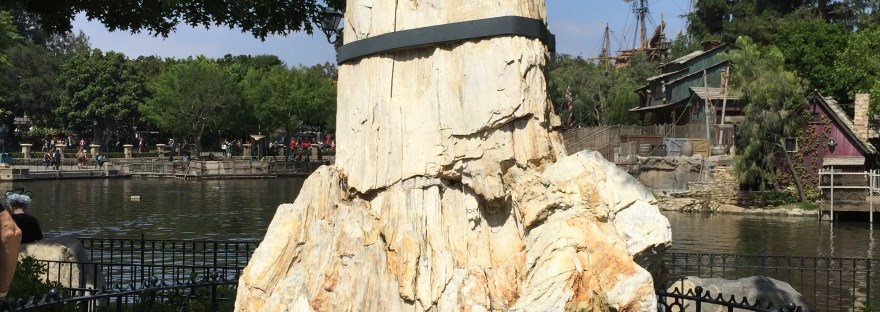
As a geologist and a mega Disney fan, I love the petrified tree at Disneyland. Jokingly referred to as the oldest attraction in the park, the petrified tree was “gifted” to Disneyland by Lillian Disney in 1957. (Walt Disney had purchased the tree in 1956, but Lillian said the tree was “too large for the mantle at home.”) You can find the petrified tree in Frontierland in front of the Rivers of America.
However, the information on the plaque about the tree’s age and origin hasn’t been updated since it was originally installed at Disneyland (which was before plate tectonics were even discovered!), and we now know a lot more accurate information about the tree. Disney also doesn’t seem to know that all the info is very incorrect and out of date, so you can learn about the actual history of Disneyland’s petrified tree here!

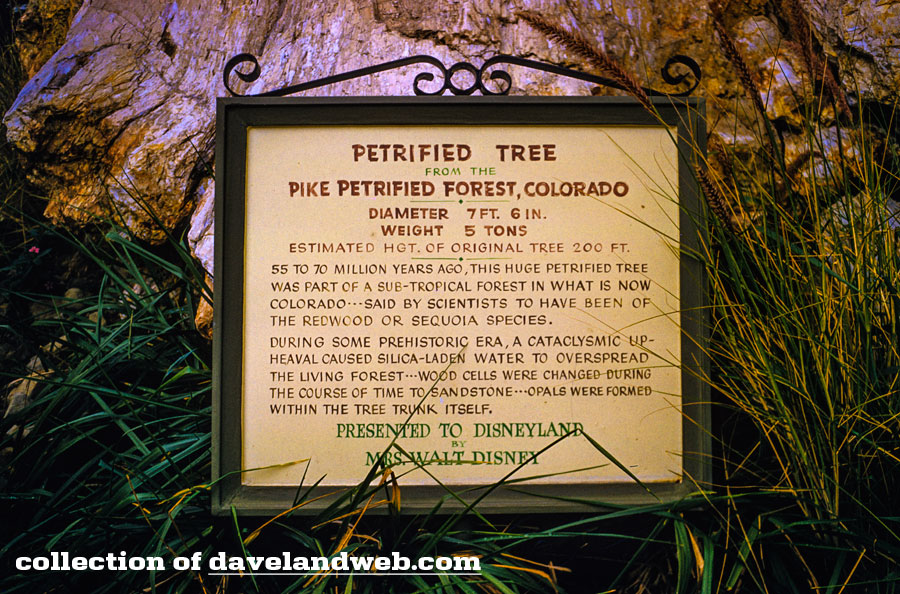
The original 1957 plaque for the tree read:
Petrified tree from the Pike Petrified Forest, Colorado.
Diameter 7 ft. 6 in. Weight 5 tons. Estimated hgt. of original tree 200 ft.
55 to 70 million years ago, this huge petrified tree was part of a sub-tropical forest in what is now Colorado–said by scientists to have been of Redwood or Sequoia species. During some prehistoric era, a cataclysmic upheaval caused silica-laden water to overspread the living forest–wood cells were changed during the course of time to sandstone–opals were formed within the tree trunk itself.
Presented to Disneyland by Mrs. Walt Disney
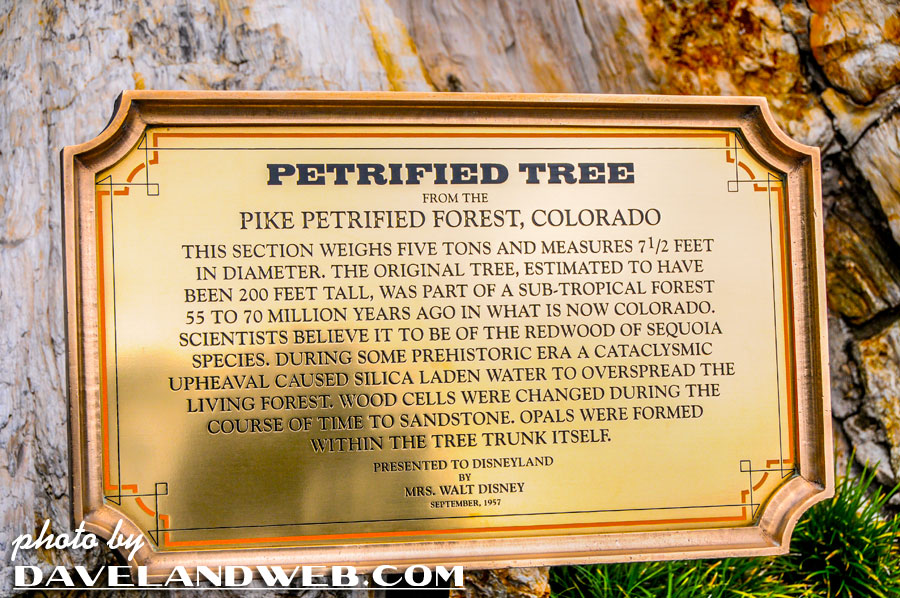
The modern sign for the tree includes all of that same information, unchanged except for slightly different formatting and wording.
Petrified tree from the Pike Petrified Forest, Colorado
This section weights five tons and measures 7 1/2 feet in diameter. The original tree, estimated to have been 200 feet tall, was part of a sub-tropical forest 55 to 70 million years ago in what is now Colorado. Scientists believe it to be of the Redwood or Sequoia species. During some prehistoric era a cataclysmic upheaval caused silica laden water to overspread the living forest. Wood cells were changed during the course of time to sandstone. Opals were formed within the tree trunk itself.
Presented to Disneyland by Mrs. Walt Disney, September 1957
The plaque lists the tree as coming from the Pike Petrified Forest in Colorado, which was accurate in 1957. The petrified forest at this time was privately owned, hence why Walt was able to purchase a tree from there. However, the National Park Service later acquired the property, and Congress established the Florissant Fossil Beds National Monument in 1969. You can visit the many in situ siblings of the Disneyland petrified tree at the Florissant Fossil Beds National Monument today. Most of the Florissant petrified trees are redwoods, similar to the modern Redwoods in California and Oregon.
While in 1957 the tree was estimated to be between 55 to 70 million years old, we have robust radiometric dating today to know its actual age. The Florissant Formation where the tree comes from has been dated to 34 million years old (Evanoff et al., 2001). So we know that the Disneyland petrified tree is actually 34 million years old, decently younger than originally estimated. This places the tree during the time known as the Eocene, when modern-day Colorado had warm temperate and subtropical plants.
So how did the Disneyland petrified tree and the trees of the Florissant Fossil Beds form? In 1957, the explanation of “a cataclysmic upheaval caused silica-laden water to overspread the living forest” wasn’t too bad for a pre-plate tectonics world, but the geologic history of the Florissant Formation is now well-studied and understood.
34 million years ago, nearby explosive volcanoes spewed out loose ash and debris. When rainfall mixes with this loose volcanic material, it can create extremely fast-moving and deadly mudflows called lahars. A lahar was triggered and traveled from the flanks of the volcano toward the forest valley, rapidly trapping the tree trunks in muddy ashy material, cutting them off from oxygen and stopping decay and decomposition. The trees became petrified when dissolved silica from volcanic ash was carried into the trees through groundwater, forming quartz (and opal) within the tree’s cells.

So the plaque saying “wood cells were changed during the course of time to sandstone” tries to capture the permineralization process petrified trees go through (since sandstone is often composed of quartz, which is the main form of silica), but sandstone is a specific type of sedimentary rock and it’s misleading in terms of what happens during petrification.
To recap, the Disneyland petrified tree is 34 million years old and comes from the Florissant Fossil Beds in Colorado. The trees there were petrified when a lahar encased the tree trunks, and silica in groundwater from volcanic ash deposited minerals within the wood cells.
You can learn more about the petrified forest of the Florissant Fossil Beds here and watch an excellent video reconstructing the history of the Florissant area here.
 Emily Zawacki, Ph.D.