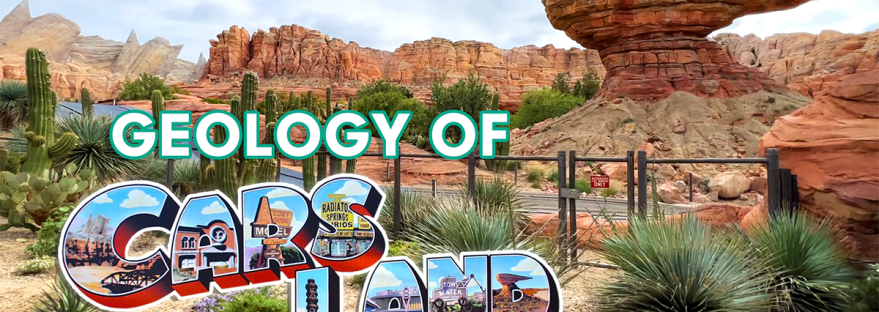
Pack your bags and get ready to motor west along Route 66, as we uncover the geology of Cars Land in Disney California Adventure.
Cars Land transports guests to the town of Radiator Springs in beautiful Ornament Valley, bringing the setting of the movie to life.
As a geologist and someone who lived in Arizona for nearly a decade, I absolutely love Cars Land. The fictional location of Ornament Valley draws its real-life inspiration from Monument Valley in northeast Arizona and southeast Utah, a truly spectacular southwestern landscape.
And if you know where to look, there are so many wonderful geologic easter eggs in Cars Land that help tell the story of the fictional rocks of Ornament Valley, as well as the very real rocks of the American southwest.
So join me, as I share more than you could ever possibly hope to know about the geology of Cars Land.
Overlooking Radiator Springs Racers, you’ll find this viewpoint with National Parks-style signs that highlight the features of Ornament Valley and describe how the rocks formed.
The sign explains that “These magnificent buttes, pinnacles, and tailfins represent sedimentary layers of soft red shale, sandstone, and limestone exposed by millions of years of wind, rain, and black ice erosion.”
And indeed, shale, limestone, and sandstone are the types of sedimentary rocks that you see all over the southwest, and it’s the difference in the properties of these rocks that result in such stunning erosional features, known as differential erosion.
Sandstone and limestone are very strong, erosionally-resistant rocks and they tend to erode to form vertical cliff faces, while shale is a weak rock that erodes quite easily, forming shallow slopes and benches. So the different resistances of these rocks as they’re layered means they erode at different rates, leading to such unique and impressive features like the iconic buttes and pinnacles.
The sign also notes that: “Other contributors to the ornament formations are the combined forces of the Radiator River,” which we’ll assume is a stand-in for the Colorado River, “and the Lincoln Continental Drift.”
“Lincoln Continental Drift” is a fun cars-meets-geology pun. You have Lincoln Continental, the car, and then Continental Drift, which was a hypothesis developed by Alfred Wegner in the early 1900s that stated that the continents moved or drifted over time; essentially a precursor to the plate tectonics that we know today.
We get more fun car-geology lingo with the information that “most of the rocks are from the Automozoic Period,” which plays on the names of different geologic Eras, like the Paleozoic, Mesozoic, and Cenozoic.
The sign continues to explain that “the stunning colors of this landscape are created as iron and other minerals stain the steep rock wall surfaces, caves, and wheel wells,” which we’ll circle back to later.
Now, this next part irritates me because it’s both wrong and lazy, which states: “The Cadillac Range was formed when the west-ward moving North American Plate collided with the eastern-moving Pacific Plate.”
So first off, a few sentences ago we just established that Continental Drift contributed to the formations, but I guess now we have full on plate tectonics.
Secondly, the tectonics are totally wrong. Looking at plate motion relative to Europe, we can see that the North American Plate is moving west-southwest, and the Pacific Plate is moving northwest. There is no collision between these plates; the boundary between them is a transform boundary, where the plates slide alongside each other.
Instead of the Pacific Plate, they actually mean the Farallon Plate. From about 180 to 30 million years ago, the Farallon Plate collided with and subducted under the North American continent, causing significant deformation in the western U.S. By 30 million years ago, most of the Farallon Plate had been subducted under North America, bringing the Pacific Plate in contact with the North American Plate, and forming the transform plate boundary.
I could talk a lot more about the Farallon Plate and uplift of the Colorado Plateau and details of southwestern geology, but I will save this video from being an hour long.
Suffice it to say that it’s very lazy to use the names of real tectonic plates, not even car puns, and get none of the tectonics right.
The last section gives us more fun car-rock names discussing the oldest schists and gneisses of the region, with ‘LaSalleous, Eldoradomorphic, and Coupe Group.’
And that segues into a visual depiction of the rocks layers, a stratigraphic column.
Now if you’re a geologist who knows anything about the southwest, you will immediately recognize that this is a stratigraphic section of the Grand Canyon.
So although Ornament Valley is Monument Valley, I guess its rocks are those of the Grand Canyon. Because the Grand Canyon is so deep, it exposes much older rocks than what you find in Monument Valley. The very youngest rocks in the Grand Canyon are actually around the same age as the oldest rocks that you see in Monument Valley, about 280 million years old.
(Now I, personally, would have chosen Canyonlands National Park in southern Utah, a bit north of Monument Valley, as the location to base the stratigraphy on, but I guess the Grand Canyon is flashier.)
Now, there’s three main generations of rocks in the Grand Canyon. You have the very old basement rocks, as the sign noted these are our schists and gneisses.
Then there’s an unconformity, an erosional gap in the geologic record, before a series of rocks were deposited, then faulted and tilted. After which there’s another unconformity, and the deposition of many layers of sedimentary rocks.
Now, I have some bones to pick with lazy mistakes. First, they put huge layers of quartzite and granite in the young group of rocks, when it should only be the large formations of sandstones, limestones, and shales, like the sign said in the first sentence. Those igneous and metamorphic rocks would be found in the older rock groups.
Second, remember how I said that sandstones and limestones form steep cliffs and shales form shallow benches and slopes? Well, they had no regard for that by labeling cliff-layers as shales, and sloped-layers as sandstones.
Now, you might think that all these names are just made up car puns, but the Redwall Limestone is actually the name of a real formation in the Grand Canyon, so it’s sad they gave it to the smallest layer here.
The real Redwall Limestone gets its name because the surface of the rock is stained red from the runoff of overlying red rocks–the actual color of the rock itself is off-white.
This brings us back to how the sign said, “iron and other minerals stain the steep wall surfaces.” When rocks in arid and semi-arid environments are stained on their surface, that is known as a ‘desert varnish.’
While just the surface of the Redwall Limestone is stained red, other rock units in the southwest are red because every individual grain is covered in a thin coating of iron oxide, or rust–kind of like the hard candy coating on the outside of an M&M.
I also think they should have given the Redwall Limestone more importance, because the real Redwall Limestone has many caverns, which brings us to Tail Light Caverns.
Now, our sign says Tail Light Caverns started forming “3 million years ago, as acidic groundwater seeped down and began dissolving the rock,” which is how the caves in the Redwall Limestone formed, except that those started forming around 330 million years ago.
The next sentence reveals what the actual inspiration for Tail Light Caverns is. The sign says, “At the same time, hydrogen sulfide gas migrated upward from oil deposits to turn the underground water into sulfuric acid.”
And what real-world cave system was formed from hydrogen sulfide seeping upwards from petroleum reserves below? Well none other than Carlsbad Caverns in far southeastern New Mexico.
Carlsbad Caverns is unique because most caves don’t form from sulfuric acid coming from below; caves typically form from acidic rainwater, which becomes carbonic acid, coming from above.
Now even though Carlsbad Caverns takes us very far away from both Monument Valley and the Grand Canyon, you can see why they used it as the inspiration for Cars Land because you take one letter away and it becomes ‘Carsbad Caverns.’
We come back to the fun cars-geology terms with descriptions of an “incredible array of stalaclight and stalaglight formations,” a play on stalactite and stalagmite. You can remember the difference in these cave formations because stalactites hold on tight to the ceiling, and stalagmites might grow up from the ground. And you get to travel through Tail Light Caverns and see the ‘stalaclight’ and ‘stalaglight’ formations at the end of Radiator Springs Racers.
So now that we know more about the rocks of Cars Land and their real life inspirations, let’s look at some of the main landscape features and formations.
The sign indicates the “Lincoln Continental Divide,” which now makes two Lincoln Continental puns. The Continental Divide is the dividing point between everything that drains out to the Atlantic Ocean, and everything that drains out to the Pacific Ocean.
If we’re in northern Arizona, we’d be west of the continental divide, so it should have been marked as the easternmost feature on the sign.
One of the most prominent features here is Radiator Cap, a cars-ified version of the buttes of Monument Valley–I feel it’s most reminiscent of Merrick Butte. So we know there has to be soft rocks on the bottom, and a hard resistant cap of rocks on top.
There’s then Mount Ever Rust, a fun play on Mount Everest in the Himalaya.
And then we have the iconic Cadillac Range, which specifies Mount 57 through 62.
The Cadillac Range plays homage to Cadillac Ranch in Amarillo, Texas. This art installation features ten Cadillacs, one from each year between 1949 to 1963 that are buried in the ground with their tail fins pointed up.
So the numbers of the different Cadillac Range mountain peaks pay homage to the different year Cadillacs from Cadillac Ranch.
Now, earlier I did not like the sign’s explanation for the formation of the Cadillac Range with the wrong tectonic plates. Since these are rocks that mimic an art installation rather than actual geology, there’s not really a geologic process that can perfectly explain its formation, especially given that most of the other rocks here are horizontal and undeformed.
Rather than forming from plates colliding together, the Cadillac Range is more reminiscent of rocks being normal faulted and tilted.
Mountains can also form from the crust being stretched out, and the mountain peaks are vaguely reminiscent of basin and range geology, where the crust is stretched and blocks of rock get tilted.
The mountain peaks could also be like an erosional remnant of a monocline, where there’s a single bend in the layers of rocks, a feature that you do see on the Colorado Plateau.
Based on the Carburetor Canyon name, it feels like a perfect play on Cataract Canyon, a canyon in Canyonlands National Park, which, again, I feel should have been the rock inspiration over the Grand Canyon.
Another fun feature here is Pipe’s Peak; this is a great recreation of a precariously balanced rock. A precariously balanced rock is exactly what it sounds like, a rock that is in a precarious position and looks like it could easily topple. These rocks are good indicators that the region hasn’t experienced strong enough shaking in its lifetime to make it fall.
The “petrol-glyphs” of Double Clutch Gulf are a fun play on petroglyphs, images carved into rock varnish that you can find in places like Petrified Forest National Park, right along Route 66 in Arizona.
Firewall Falls notes that the waterfall plunges over the area’s most erosionally-resistant rock formation, which makes sense, since otherwise the river would have carved through it.
We also get more backstory on the Radiator River, our stand-in for the Colorado River. The sign notes that the source of the river is Cracked Block Rock National Park. The Colorado River begins in Rocky Mountain National Park in Colorado, so I feel like Cracked Block Rock plays on that, and a cracked engine block.
The Radiator River “flows through Firewall Falls and continues through the valley before turning abruptly west at the Grand Prix Canyon.” The Grand Prix Canyon is obviously the Grand Canyon, which is what the stratigraphic column is based on.
Then we get to Willy’s Butte, which is arguably the most iconic feature in Cars Land. This rock formation is modeled after the hood ornament of a Willys car, but it also bears a striking resemblance to Mexican Hat Rock in Utah just a bit north of Monument Valley, a beautiful product of differential erosion that seems to defy gravity.
As I explained before how Carlsbad Caverns was the inspiration for Tail Light Caverns, we do also have a Cars Bad Caverns here.
And then lastly you have Lost Wheel Arch, bringing in a bit of the iconic scenery of Arches National Park in Utah, and Mount Hood, clever erosion to mimic a car hood and ornament. This formation is really fun, especially when looking at it from farther away because it lets you really see the car inspiration in the landscape.
William Cone, Production Designer on the Cars movie, said in a behind the scenes interview, “I felt as humans tend to see their own forms in nature, that if cars were the beings in the world, that they would see their forms in nature.”
And that’s part of what makes the geology of Cars Land so magical, the way that subtle car touches are integrated into the natural landscape.
Beyond what specifically is highlighted on the sign, there’s many other great geologic details in the rockwork.
You’ll notice that there’s some whiter horions in the colored rocks. This could either reflect areas that have lost their desert varnish surface coating, or it could be that these horizons had larger grains, which made it easier for groundwater to flow through and not coat the grains in iron oxide, as you can observe in Sedona, Arizona.
There’s also really beautiful examples of cross-bedding in the rocks. See how it looks like these rock layers were tilted? Well they were actually deposited like that. Sediment carried by either wind or water were deposited on the inclined slopes of bedforms, like dunes and ripples, as they migrated. So the direction that the cross-beds are sloping can actually tell you what direction the wind or water was flowing in.
You can also see distinct changes in rock type–different colors and different resistances–reflecting a change in depositional environments, as well as shallow talus slopes from soft rocks like shale, to steep cliffs from sandstone and limestone.
And little rockfall piles give you the sense that this is a real, geologically active environment.
So next time you visit Cars Land, take a minute to appreciate the masterful blending of southwestern geology with all things cars-related.
 Emily Zawacki, Ph.D.